
Whoever be the speaker, whatever be the content, to find the truth is the role of wisdom
— Verse 423, Thirukkural
Thirukkural – The Timeless Wisdom
Thirukkural stands as one of the most celebrated works on ethics, morality, and the art of living. Written in classical Tamil sometime between 31 BCE and 500 CE, this masterpiece has endured centuries and continues to remain universally relevant. With 1330 concise couplets known as “Kurals,” it covers every facet of human life—from righteousness and governance to love and personal conduct.
Little is known about its author, Thiruvalluvar, or Valluvar as he is affectionately called. What we know comes only through anecdotes and references in other literary traditions. Yet, Thirukkural has become the most translated work of ancient Tamil literature, a timeless text that speaks across religions, languages, and philosophies.
This work has historically been divided into three major sections:
- Araththuppaal (Righteousness) – 380 Kurals
- Porutpaal (Wealth) – 700 Kurals
- Kaamaththuppaal (Love) – 250 Kurals
Their beauty lies in brevity—each verse is only seven words long, yet it carries immense philosophical depth. As verse 423 reminds us: “Whoever may speak and whatever be the content, the role of wisdom is to discover the truth.”
Here is a brief intro to the work to a non-Tamil speaker
Thirukkural is One of the World’s Most Translated Works
Thirukkural is indeed one of the most translated works of Tamil literature and is considered among the most translated ancient works in the world. It has been translated into more than 57 languages, with over 350 individual translations documented. Alongside the Bible and the Quran, Thirukkural remains one of the most translated texts globally due to its universal themes of ethics, morality, and practical wisdom.
Its extensive translation history spans centuries, beginning with the first known Malayalam translation in 1595 CE, and continuing into the present day with new translations even in less common languages. This wide linguistic reach reflects Thirukkural’s universal appeal and adaptability across cultures and eras.
Why Another Translation?

This project is deeply personal. It began with my mother, Anantharani T, who during the last five years of her life dedicated herself to translating Thirukkural into English. She passed away during the Covid pandemic in 2021, but one of her final wishes was to make Thirukkural interesting for the younger generation.
Her insight was simple yet profound: most existing translations were either shaped by English speakers who had learned Tamil—often resulting in westernized tones—or by Tamil scholars with limited fluency in English, making them difficult for a wider audience to enjoy. As a Tamil speaker with over 30 years as a lecturer in English, she wanted to bridge both worlds and create a version that was simple enough to read, yet still faithful to Valluvar’s voice.
Her vision was for a bilingual edition, with Tamil verses on the left and English interpretations on the right. Whether or not one knows Tamil, the book could be read like any other philosophical classic—just as we read Plato or Confucius in translation, rarely questioning what was lost.
After her passing, I, Bhagath Singh K, built upon her translation. While she leaned closer to translation, I expanded into interpretation, aiming for a broader and modern self-help perspective. Importantly, I have also addressed sections that may clash with contemporary human rights values. In such cases, I sometimes neutralized the phrasing, while in others I left the original intact for the reader to interpret.
This edition, therefore, is not merely a translation but a dialogue between the ancient wisdom of Thiruvalluvar and the modern reader.
This Book – Porutpaal (The Chapter on Wealth)
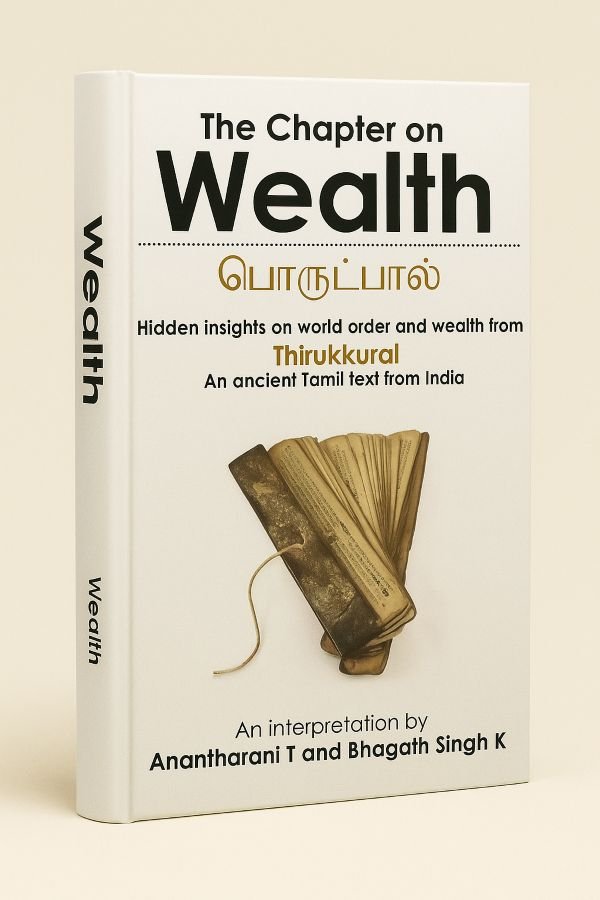
The first volume published focuses on Porutpaal—the section on Wealth, comprising 700 verses (381–1080). This part explores:
- The virtues of good governance
- The qualities of ministers and advisors
- Defense, military, and surveillance
- Friendship, community, and social structures
For readers new to Thirukkural, Porutpaal provides an excellent starting point. It communicates not abstract ideals, but practical wisdom for leadership and society—topics that remain strikingly relevant even today.
Buy Book
Future planned volumes will complete the cycle:
- Kaamaththuppaal (The Chapter on Love)
- Araththuppaal (The Chapter on Righteousness)
Much like the works of Greek or Chinese philosophers often quoted today, I hope English interpretations of Thirukkural will one day find equal presence in conversations on ethics, governance, and philosophy worldwide.
About Our Facebook Community
Alongside this book project, there is a vibrant Facebook community with over 30,000 followers dedicated to sharing the wisdom of Thirukkural. The page serves as an interactive platform where enthusiasts from around the world engage with translations, interpretations, and daily reflections based on Thirukkural verses.
It is a space designed especially for the younger generation and non-Tamil speakers to connect, discuss, and find inspiration from Valluvar’s teachings in a modern context. Regular posts feature curated verses, explanations, questions for reflection, and discussions encouraging active participation.
If you appreciate the essence of Thirukkural and want to explore its timeless wisdom in a communal and accessible way, following our Facebook page is an excellent way to stay connected and deepen your understanding.
Please visit and join the conversation to be part of this growing global family celebrating the legacy of Thiruvalluvar.
Facebook Page | 30000+ Followers
Dedication
To my parents, who lived in Usilampatti, for protecting and enabling me with education. But for them, I would have been a victim of infanticide. And to my beloved husband, Karunakaran, and my loving children, Bhagath and Nisha.
– Anantharani T
To my Parents and Teachers
– Bhagath Singh K
How can you help us?
Like | Share | Subscribe
If this work resonates with you, share your feedback in the comments below. Please follow our Facebook page to stay updated, and help spread these timeless verses by sharing them with your friends and family.